
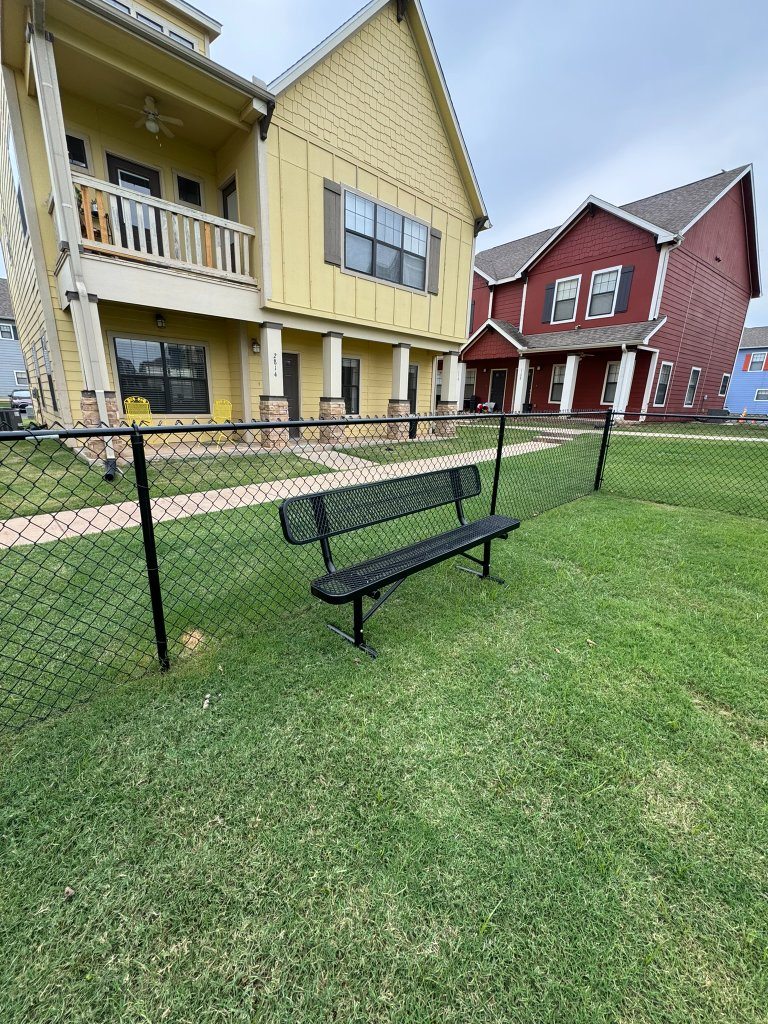
Natural-grass lawn with a bench beside black fencing and residential buildings. Context photo of natural grass; it does not identify or diagnose the condition discussed in this article.
Photo by Advanced Turf Services• © Advanced Turf Services
Common Lawn Diseases in Stillwater, OK
Learn how to separate possible lawn disease from drought, irrigation gaps, compaction, mowing damage and soil problems in a Stillwater lawn.
Brown, yellow, thinning, or circular patches do not automatically mean a Stillwater lawn has a disease. Heat stress, uneven irrigation, compacted soil, dull mower blades, insects, pet traffic, and chemical injury can create similar symptoms. Correct identification should come before any treatment.
Signs that may point to disease
Look at the pattern, not just the color. Useful clues include:
- Circular or irregular patches that continue expanding
- Spots, bands, or lesions on individual grass blades
- A smoky, matted, or web-like appearance early in the morning
- Damage concentrated in damp, shaded, or poorly drained areas
- Symptoms that appear after a weather change or a shift in watering
Photograph the affected area and several close-up blades before mowing. Note when the problem began, recent rainfall or irrigation, and any product applied to the lawn.
Problems commonly confused with disease
Drought and irrigation gaps
A sprinkler pattern can leave repeated dry arcs or edges. Probe the soil in both healthy and damaged areas, and check heads for blockage, tilt, or poor overlap. Waterlogged soil can also weaken roots and resemble disease.
Mowing stress
Scalping, tearing from a dull blade, or removing too much growth at once can leave turf pale or brown. Follow the one-third rule and adjust mowing height for the grass type and season.
Compaction and drainage
Dense soil reduces air movement and root growth. Areas beside drives, gates, play spaces, and equipment routes often thin first. Core aeration may help compacted turf, while standing water may require a drainage evaluation.
Nutrient or soil problems
Uniform yellowing can come from nutrition, root stress, or soil chemistry. A soil test is more useful than choosing fertilizer based only on color.
Disease patterns seen in Oklahoma turf
Warm, humid conditions can favor leaf and crown diseases. Bermudagrass may show spring dead areas after winter stress, while cool-season turf can decline during prolonged heat and moisture. Fungal activity is influenced by temperature, leaf wetness, airflow, drainage, grass species, and recent fertilizer use.
Because several conditions look alike, avoid choosing a treatment solely from an online photo. The wrong product will not correct irrigation, compaction, or mowing damage.
Prevention starts with routine care
Healthy turf is more resilient. Focus on:
- Watering deeply enough for the soil and grass type without keeping foliage wet unnecessarily.
- Mowing at an appropriate height with a sharp blade.
- Avoiding heavy fertilizer applications that force weak, rapid growth.
- Improving airflow and light where dense shrubs or low branches keep turf damp.
- Removing only necessary thatch and aerating compacted areas at the correct season.
- Correcting recurring drainage problems.
- Cleaning equipment after mowing a visibly affected area.
Bagging clippings is not automatically required. It may be useful during a confirmed active problem, but routine clipping return can be appropriate when the lawn is healthy and mowing is timely.
When to request help
Request an on-site evaluation when damage spreads quickly, returns in the same area, affects a large section, or cannot be separated from irrigation, soil, or insect problems. Bring your observations and application history so the cause can be narrowed down.
Advanced Turf Services provides lawn care and site evaluations in Stillwater. Request an estimate to discuss the condition of your turf and the next practical step.
Planning an Outdoor Project?
Get a free estimate for your property in Stillwater, OK
Get Free EstimateRelated Articles
Why Is My Lawn Turning Brown During This Heatwave?
Brown lawn in Stillwater? Check moisture, mowing, irrigation and damage patterns before treating. Learn when to seek a lawn assessment.
Top 7 Tips for a Healthy Lawn in Stillwater
Discover the top 7 expert tips for a lush, healthy lawn in Stillwater, OK. From soil testing to seasonal care, learn how to beat the Oklahoma heat.
How Much Does Lawn Care Cost in Stillwater, Oklahoma?
Wondering about lawn care costs in Stillwater, OK? Learn what factors influence pricing and how to budget for a healthy, vibrant lawn in Payne County.