
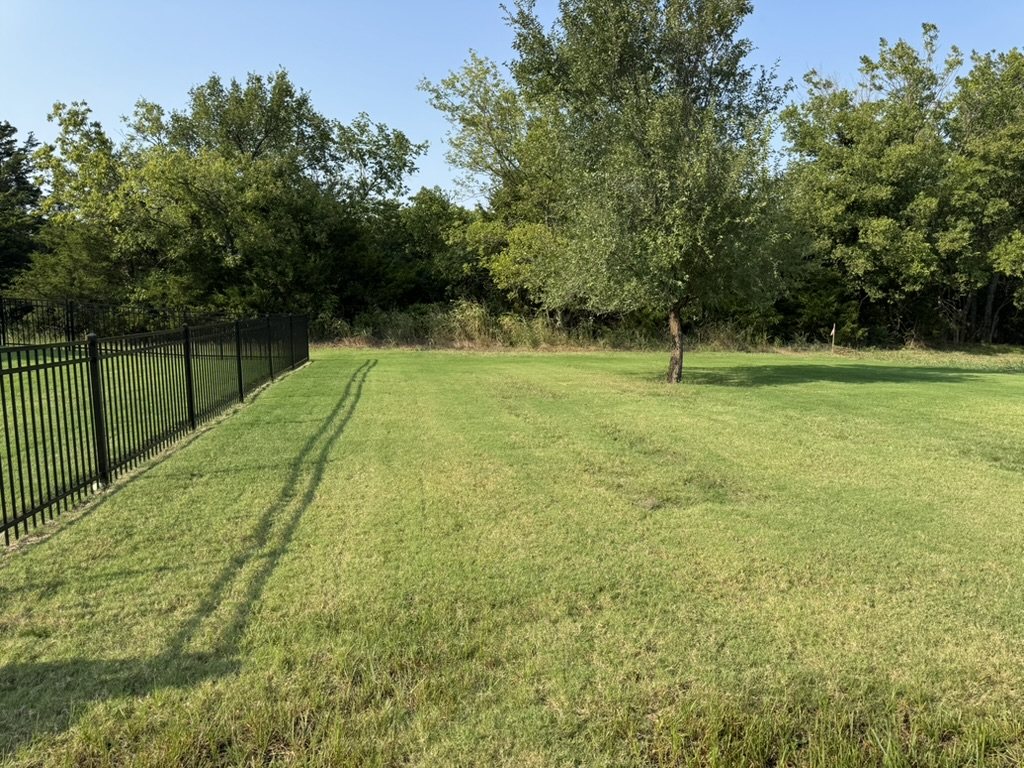
Mowed natural-grass lawn beside a black metal fence and mature trees.
Photo by Advanced Turf Services• © Advanced Turf Services
How Often Should You Fertilize Your Lawn in Oklahoma?
A practical Stillwater lawn-fertilizing guide based on grass type, soil testing, seasonal growth and responsible application—not a one-size-fits-all schedule.
There is no single fertilizing schedule that fits every Stillwater lawn. Grass type, soil test results, irrigation, shade, mowing habits, and the condition of the turf all affect how often fertilizer should be applied.
Start by identifying the grass
Warm-season grasses such as bermudagrass grow most actively after the lawn has fully greened up and soil temperatures have warmed. Cool-season grasses such as tall fescue have a different growth cycle and usually receive their most important feeding during cooler parts of the year.
Treating both the same can waste product or push growth at the wrong time. If the lawn contains more than one grass type, the plan may need separate treatment areas.
Test before adding more fertilizer
Color alone does not prove a fertilizer deficiency. Compaction, drought stress, poor drainage, disease, insects, a dull mower blade, and soil chemistry can all create a weak or discolored lawn.
A soil test helps identify nutrient levels and pH so the program can be based on the property rather than guesswork. Follow the laboratory recommendation and the product label instead of assuming that more fertilizer will produce a better lawn.
A practical schedule for warm-season lawns
For an actively growing bermudagrass lawn, fertilization is generally considered during the warm growing season after green-up. The number of applications depends on the desired appearance, irrigation, mowing frequency, and soil results. A lower-maintenance lawn may need fewer applications than intensively managed turf.
Avoid pushing tender growth too early in spring or too late before dormancy. Weather and actual turf growth should guide timing.
A practical schedule for cool-season lawns
Tall fescue and other cool-season lawns generally benefit most from a fall-centered plan. Heavy feeding during Stillwater heat can add stress and increase water demand. Spring applications, when appropriate, should be based on lawn condition and soil-test guidance.
Application quality matters
Uniform coverage and the correct amount are as important as timing. Clean fertilizer from pavement, driveways, and storm-drain paths. Do not apply immediately before heavy rain, and do not fertilize drought-stressed turf simply to force color.
When to call a professional
Professional help is useful when the grass type is unclear, the lawn has recurring yellow or bare areas, previous applications have produced uneven results, or you want a documented seasonal program.
Advanced Turf Services has operated since 2008 and provides fertilizer services under Oklahoma Fertilizer License 4143606269, Category TA, valid through December 31, 2026. Explore lawn fertilization in Stillwater or request an estimate for a plan matched to your property.
Planning an Outdoor Project?
Get a free estimate for your property in Stillwater, OK
Get Free EstimateRelated Articles
Why Is My Lawn Turning Brown During This Heatwave?
Brown lawn in Stillwater? Check moisture, mowing, irrigation and damage patterns before treating. Learn when to seek a lawn assessment.
Top 7 Tips for a Healthy Lawn in Stillwater
Discover the top 7 expert tips for a lush, healthy lawn in Stillwater, OK. From soil testing to seasonal care, learn how to beat the Oklahoma heat.
How Much Does Lawn Care Cost in Stillwater, Oklahoma?
Wondering about lawn care costs in Stillwater, OK? Learn what factors influence pricing and how to budget for a healthy, vibrant lawn in Payne County.